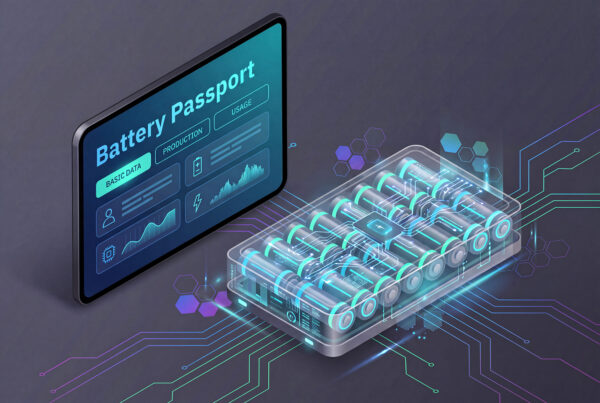

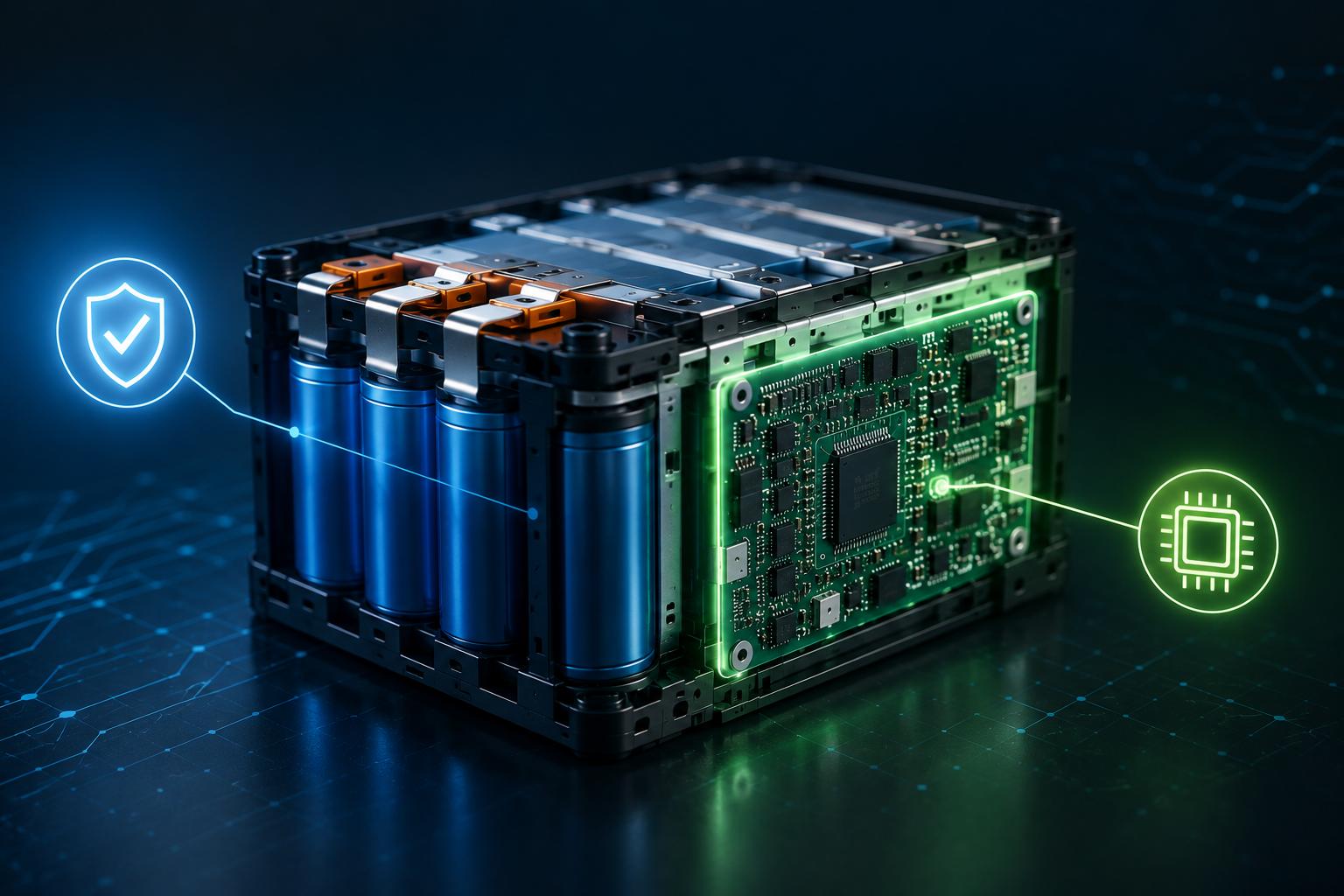
In the real world, energy is not simply managed. It must be monitored, protected and controlled reliably throughout the entire battery lifecycle.
That is why we develop and manufacture complete lithium battery systems for AGVs, lighting towers, small electric vehicles, and Battery Energy Storage Systems (BESS).
At the heart of every system is Archimede BMS, our proprietary Battery Management System designed to transform a battery pack into a safe, controllable, and easily integrated industrial asset.
Why a BMS is essential in industrial batteries
When evaluating an industrial battery, the focus is not limited to capacity, voltage, or runtime.
For designers, system integrators, and plant managers, the key priorities are:
- Operational reliability
- Reduced machine downtime
- Ease of integration
- Data availability
- Long-term performance predictability
An advanced BMS helps achieve these objectives by continuously monitoring cells, temperatures, currents, and battery health status.
The concrete benefits of Archimede BMS
Less downtime and fewer anomalies
Advanced protection systems based on temporal filters, hysteresis, and state-machine logic reduce false alarms and unnecessary shutdowns without compromising system safety.
Extended lithium battery life
Intelligent balancing and controlled management of operating limits reduce cell stress and help maintain stable performance over time.
Reduced integration time
Thanks to pre-configured profiles and drivers already available for major industrial devices, the time required to integrate the battery into the system is significantly reduced.
Reliable data for maintenance and service
SOC, SOH, charged and discharged energy, diagnostic logs, and operating data simplify maintenance activities and speed up troubleshooting.
Archimede BMS features
1. Cell-by-Cell monitoring and temperature control
The quality of a Battery Management System starts with measurement accuracy.
Archimede BMS continuously monitors:
- Voltage of every individual cell
- Module temperatures
- Minimum, maximum, and average values
- Potential cell imbalances
This approach allows anomalies to be identified before they become failures or cause system downtime.
2. Advanced protection functions for industrial lithium batteries
Protection systems are not simply software thresholds.
They are control logics specifically designed to ensure predictable and safe battery behavior under all operating conditions.
Key features include:
- Over-voltage and under-voltage protection with temporal filtering
- User-defined limits separated from absolute safety limits
- Over-temperature and under-temperature protection with hysteresis
- Diagnostic error management
- Dedicated state machine (STANDBY, CHARGE, DISCHARGE, TRANSITIONAL)
- Charge and discharge enable control
The result is an industrial battery that behaves like a mature, reliable product rather than a simple prototype.
3. Intelligent cell balancing
Balancing is one of the most important factors in preserving lithium battery efficiency.
Archimede BMS uses configurable balancing strategies based on:
- Customizable thresholds
- Operating conditions
- Adjustable duty cycle
- Controlled activation and deactivation
This approach delivers greater effectiveness, lower invasiveness, and improved long-term performance predictability.
4. Advanced SOC, SOH and energy calculation
One of the key strengths of Archimede BMS is the quality of the information it provides.
The system calculates:
State of Charge (SOC)
Based on coulomb-counting algorithms corrected through:
- Temperature compensation
- Energy efficiency correction
- Battery health condition
State of Health (SOH)
Evaluated through models that consider:
- Equivalent cycles
- Operating temperature
- C-rate
- Cell chemistry
Charged and Discharged Energy
Continuous monitoring of transferred kWh for performance analysis and predictive maintenance.
Future development: UKF-Based SOC Estimation
We are currently developing an SOC estimation system based on the Unscented Kalman Filter (UKF).
This approach will provide:
- Greater accuracy under real operating conditions
- Reduced drift over time
- Improved reliability during transients and variable current conditions
5. Advanced logging for analysis and diagnostics
In many industrial applications, data is critical.
For this reason, Archimede BMS includes an SD-card logging system specifically designed to ensure:
- Protection against sudden power interruptions
- Data recovery after glitches
- Advanced write-error management
- Stored record integrity
When it becomes necessary to reconstruct an event or investigate an anomaly, data remains available and accessible.
Fast integration with inverters, chargers and control systems
An industrial battery must integrate seamlessly with the rest of the system. Archimede BMS includes ready-to-use profiles and drivers for:
- Studer (Xcom‑CAN): Battery data and status broadcasting.
- Victron: Measurements, SOC/SOH information, limits, warnings, and alarms.
- J1939: Integration in industrial and vehicle environments.
- Charger multi‑vendor: drivers are already available for several traditional charger manufacturers, including: Zivan, DeltaQ, Atib, Brusa; and wireless charging systems such as: Enrx, Wiferion, Buzzard, Delta.
- CANopen: available when required in automation-centric architectures.
FAQ – Battery Management System (BMS)
What is a battery management system (BMS)?
A Battery Management System (BMS) is the electronic system that monitors, protects, and controls a lithium battery.
Its role is to ensure safety, reliability, and long-term performance by managing parameters such as cell voltage, current, temperature, and state of charge.
Why Is a BMS essential in industrial lithium batteries?
In industrial applications, a battery must do more than store energy—it must operate reliably and predictably.
An advanced BMS protects cells from critical operating conditions, reduces the risk of downtime, extends system life, and provides valuable maintenance and diagnostic data.
What data does a BMS monitor?
A Battery Management System continuously monitors:
- Individual cell voltage
- Module temperature
- Charge and discharge current
- State of Charge (SOC)
- State of Health (SOH)
- Charged and discharged energy
- Alarms and fault conditions
This information provides a real-time picture of battery operating status.
What is the difference between a BMS and an EMS?
The BMS (Battery Management System) manages the battery itself and ensures its proper operation.
The EMS (Energy Management System) operates at a higher level and coordinates energy flows throughout the entire system, managing batteries, inverters, photovoltaic generation, the electrical grid, and loads.
In a BESS installation, BMS and EMS work together but perform different functions.
Is a BMS necessary in a BESS System?
Yes.
In a Battery Energy Storage System (BESS), the BMS is essential for monitoring battery status, applying safety protections, managing operating limits, and providing reliable data to the inverter and EMS.
Without a suitable BMS, proper system operation cannot be guaranteed.
How is state of charge (SOC) calculated?
State of Charge (SOC) represents the amount of energy available in the battery compared to its total capacity.
Advanced systems use coulomb-counting algorithms corrected through models that account for temperature, energy efficiency, and battery operating conditions to provide more accurate estimations.
What is state of health (SOH)?
State of Health (SOH) indicates the level of battery aging compared to its original condition.
This parameter helps evaluate remaining capacity, monitor degradation over time, and plan maintenance or replacement activities.
Which communication protocols does Archimede BMS support?
Archimede BMS supports several communication interfaces commonly used in industrial and vehicle applications, including:
- CAN Bus
- J1939
- Victron
- Studer Xcom-CAN
- Dedicated charger communication protocols
- Energy storage communication protocols
CANopen solutions are also available for industrial automation architectures.
Which applications can use Archimede BMS?
Archimede BMS is designed for industrial applications requiring high reliability and simplified integration, including:
- AGVs and autonomous mobile robots
- LED lighting towers
- Small electric vehicles
- Industrial machinery
- Battery Energy Storage Systems (BESS)
- Off-grid and microgrid applications
How can battery compatibility with Archimede BMS be evaluated?
For a preliminary assessment, it is generally sufficient to provide:
- Application type
- Nominal voltage
- Maximum current
- Battery configuration
- Inverter or charger model
- Required communication protocol
This allows rapid compatibility verification and identification of any customization requirements.
Archimede BMS Applications
AGVs
- Increased operational continuity and fewer stops
- More reliable SOC estimation for charging and shift planning
- Fast CAN integration
Lighting towers
- Robust performance during intermittent operation
- Valuable service and maintenance data
- Energy counters (kWh) for performance analysis
Small electric vehicles
- Thermal and voltage protections with hysteresis, reducing unexpected cut-offs
- Support for vehicle integrations such as J1939
- Reliable diagnostic logs that reduce service returns
BESS
- Consistent charge and discharge behavior
- Integration with inverters and EMS platforms through available CAN profiles
- Energy and status data for lifecycle management
Archimede BMS was developed to meet the needs of OEMs, system integrators, and industrial machine manufacturers looking for a lithium battery solution that is easy to integrate and ready for mass production.
If you are developing an AGV, LED lighting tower, small electric vehicle, or BESS project, we can quickly assess compatibility with your application.
To perform an evaluation, simply provide:
- Application: AGV / Lighting Tower / EV / BESS
- Nominal voltage, maximum current, S/P configuration, cell chemistry
- Inverter / Charger / EMS: brand and model
- Required interface: CAN / J1939 (bitrate) and, if available, DBC file or CAN IDs
We will provide:
- Recommended architecture
- Applicable out-of-the-box integrations
- Required configuration activities and realistic timelines
- Industrialization options (production, fleet management, service support)
Want to know immediately whether our battery solution with Archimede BMS is truly plug-and-play with your system?