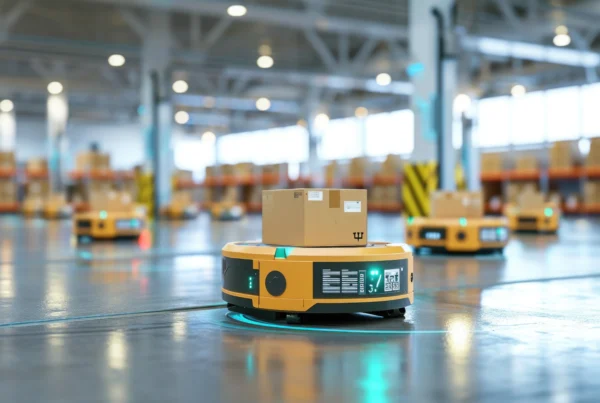


In AGV, AMR, and mobile industrial machinery systems, operational availability can be more important than maximum battery capacity. When a vehicle needs to work across multiple shifts or with minimal interruptions, stopping it for several hours to perform a full recharge can indeed become a bottleneck for productivity.
A possible alternative is battery swapping, which involves replacing the depleted battery with a fully charged unit. The operation can take just a few minutes and, in more advanced systems, can be fully automated.
Designing a swappable battery for an AGV does not simply mean adding a connector and making the battery pack removable.
Electrical architecture, behavior of the Battery Management System (BMS), communication protocol, connectors, and mechanical interface must be designed as parts of the same system. This integration becomes even more important when the vehicle must remain powered during the battery swap. It is right here that the difference between a swappable battery and a true hot-swap system emerges.
Swappable Battery vs. Hot-Swap Battery: What is the Difference?
The terms swappable battery and hot-swap battery are sometimes used as synonyms, but they indicate two different architectures.
A swappable or replaceable battery can be physically removed and replaced with a charged battery, but during the operation, the vehicle is normally powered off.
In a hot-swap system, on the other hand, a battery can be disconnected while a second battery or an auxiliary power source continues to supply power to the system.
In the case of an AGV or AMR, this means that components such as vehicle controllers, navigation computers, sensors, and communication systems can remain active during replacement. The difference thus concerns not only the time required to change the battery, but above all how power continuity is managed.
A swappable system must guarantee at least:
- safe battery removal;
- robust power connectors;
- mechanical locking system;
- battery identification;
- proper connection and disconnection procedures.
A hot-swap architecture requires additional functions, including:
- controlled power transfer;
- current sharing management;
- precharge;
- battery synchronization;
- communication continuity;
- isolation of the battery to be removed;
- protection against inrush currents.
For this reason, true hot-swap capability must be considered right from the early stages of vehicle design.
Why Can Battery Swapping Be Advantageous in AGVs?
Many industrial AGVs operate in applications where any machine downtime can affect the entire production or logistics process.
If a vehicle must operate continuously across multiple shifts, traditional charging can require larger batteries or a higher number of vehicles to compensate for downtime.
Battery swapping introduces a different logic: instead of necessarily sizing the battery to cover an entire shift, we can design the system around shorter operating intervals and swap the battery when needed.
An example could be:
AGV Autonomy → 6 hours
Battery replacement time → 2-5 minutes
Recharging → performed externally while the vehicle operates using another battery
This makes it possible to increase vehicle utilization levels without necessarily increasing the number of AGVs in the fleet.
Charging can also be centralized in dedicated stations, separating the charging process from the vehicle.
Manual or Automatic Battery Swapping?
Battery swapping in AGVs can be carried out manually or through fully automated systems.
In manual battery swapping, an operator removes the depleted battery and inserts a charged unit. It is a relatively simple solution, particularly suitable when replacement needs to be performed once or a few times during a shift.
The design must consider aspects such as:
- battery weight;
- presence and position of handles;
- extraction direction;
- force required to mate the connector;
- protection against incorrect insertion;
- locking systems;
- operator accessibility.
In the case of heavy industrial batteries, guides, slides, or mechanical support systems may be required.
In plants with a high level of automation, battery replacement can also be automated.
A robotic station can remove the depleted unit from the AGV and replace it with a charged battery, minimizing downtime.
- In this case, mechanical tolerances become particularly important. The system must be designed to manage:
- numerous insertion and extraction cycles;
- possible connector misalignments;
- vibrations;
- batteries not fully inserted;
- delays in communication initialization.
Vehicle control must also verify that the battery has been installed correctly before authorizing high-current operation.
How Is a Swappable Battery for AGVs Constructed?
A modern swappable industrial lithium battery includes far more components than just the cells.
Depending on the architecture, it can include:
- battery cells;
- Battery Management System;
- main contactors;
- precharge circuit;
- fuse;
- current sensor;
- temperature sensors;
- CAN interface;
- battery identification system;
- service connector;
- high-current power connector.
Particularly important is the sequence used to connect and disconnect these components. The BMS, for example, should not simply close the contactors immediately after inserting the battery. Before making full power available, it must verify that correct conditions are met.
A possible sequence is:
Battery insertion
↓
Detection and identification
↓
Low-voltage communication activation
↓
System voltage check
↓
Precharge activation
↓
Voltage synchronization on the DC bus
↓
Main contactor closure
↓
Precharge deactivation
↓
Battery available for operation
A controlled sequence helps limit current transients during connection.
Why Is Precharge Important in AGV Batteries?
Many components connected to the DC bus of an AGV feature input capacitors of significant capacity.
Among these, we can find:
- motor drives;
- DC/DC converters;
- inverters;
- onboard chargers.
Connecting a battery directly to a discharged DC bus can cause these capacitors to absorb a very high current for a brief interval, known as inrush current. Without a properly sized precharge circuit, these spikes can stress or damage components such as:
- connectors;
- contactors;
- fuses;
- PCB traces;
- battery protection devices.
In a swappable system, this condition can occur with every replacement.
For this reason, precharge must be an integral part of the battery swapping architecture, not simply an additional safeguard.
Parallel Batteries and Hot-Swap Systems
A true hot-swap system can use two batteries connected to the same DC bus. During normal operation, both can contribute to powering the load. When one of the two needs to be replaced, the other continues to supply energy to the vehicle.
The architecture can be represented in a simplified way as:
Battery A ─┐
├── DC BUS → AGV
Battery B ─┘
The main challenge is that the two batteries become electrically connected to each other. If their voltages differ significantly, a very high equalization current can be generated from one battery to the other. In some conditions, this current can even exceed the current drawn by the vehicle.
Why SOC Is Not Enough to Connect Two Batteries in Parallel
It might seem sufficient to check that two batteries have a similar State of Charge (SOC) before connecting them in parallel. In reality, SOC represents an estimate of residual energy and does not directly determine the instantaneous current that can flow between two battery packs.
One of the key parameters to take into account is the voltage difference, along with the overall internal resistance of the electrical path. In industrial systems characterized by very low resistances, even a relatively small voltage difference can generate significant currents.
For this reason, before connecting two batteries in a hot-swap system, it is advisable to check:
- pack voltage;
- battery temperature;
- SOC;
- operating status;
- any active alarms;
- allowable charge current;
- allowable discharge current.
The system should only authorize parallel connection when the conditions of both batteries are compatible.
Make-Before-Break vs. Break-Before-Make: Which Strategy to Use?
One of the central aspects in designing a hot-swap system concerns the sequence in which batteries are connected and disconnected.
In a break-before-make architecture, the active battery is disconnected before connecting the new one. The advantage is that the two battery packs are never placed directly in parallel.
However, for a short interval, the DC bus remains without power. If an auxiliary power source is not present, the vehicle turns off and must subsequently complete its reboot procedure.
Conversely, with a make-before-break strategy, the new battery is connected before the one in use is disconnected. For a brief period, both batteries work in parallel, maintaining uninterrupted power supply.
This architecture requires more sophisticated management, however. Before paralleling, it may be necessary to implement:
- voltage check and matching;
- controlled precharge between batteries;
- current limitation;
- coordination via CAN;
- precise contactor opening and closing sequences.
Another possible configuration exists. Instead of keeping two traction batteries connected to the same DC bus, we can use a small auxiliary battery or supercapacitor to temporarily power critical electronics systems during the main battery swap.
During battery swapping, only certain devices can remain powered, such as:
- Industrial PC;
- navigation controller;
- safety controller;
- wireless communication;
- localization system.
The traction inverter can instead remain deactivated until the new main battery is connected. This solution can simplify battery swapping by avoiding the need to manage two large traction batteries simultaneously in parallel.
CAN Communication During Battery Replacement
In modern AGVs, the battery pack is typically integrated into the vehicle’s communication network. Through the BMS and CAN protocol, information such as the following can be transmitted:
- SOC;
- SOH;
- voltage;
- current;
- temperature;
- alarms;
- maximum charge current;
- maximum discharge current;
- contactor status;
- battery identification.
During a swap, the AGV controller must recognize that a battery has been disconnected and that a new unit has been inserted. CAN network management must therefore be designed accordingly.
Batteries can be distinguished, for example, through:
- Node ID;
- serial number;
- configurable CAN ID;
- logical position in the system;
- dynamically assigned address.
In multi-battery systems, it is also essential to prevent different BMS units from transmitting messages using the same identifiers, unless the protocol has been specifically designed to handle this condition.
Battery Identification and Fleet Traceability
Unique battery identification plays a particularly interesting role in AGV fleets.
Each pack can be associated with data such as:
- serial number;
- production date;
- chemistry;
- nominal capacity;
- firmware version;
- cycle count;
- SOH;
- maintenance history.
The vehicle or the Fleet Management System can thus identify which battery is installed in a specific AGV and monitor its usage over time. In a fleet with battery swapping, the battery becomes a traceable asset independent of the vehicle on which it is used.
Battery Rotation and Fleet Management
In a system with swappable batteries, each pack spends part of its life on the vehicle and part in charging stations. This configuration allows gathering and utilizing data related to:
- operating hours;
- charging times;
- cycle count;
- operating temperatures;
- total delivered energy;
- residual capacity.
The choice of battery to use can then be managed not only based on immediate availability, but also considering health status and usage history. Proper rotation can help distribute aging more evenly among the fleet’s batteries.
How Does Charging Infrastructure Change?
Battery swapping also modifies the way charging infrastructure is designed. Instead of necessarily installing a charger on each AGV, packs can be recharged in centralized cabinets or stations.
A fleet could be configured with:
6 batteries installed on AGVs
+ 2 batteries charging
+ 1 spare battery
However, there is no universal ratio between installed batteries and spare batteries.
Sizing depends on:
- vehicle utilization rate;
- battery runtime;
- time required for charging;
- fleet size;
- peak usage demands.
For large fleets, correctly sizing the number of batteries can significantly impact both operational availability and facility CAPEX.
Mechanical Design of Swappable Batteries
A swappable battery can be designed perfectly from an electrical standpoint and still be ineffective if it is difficult to extract or reinsert. The mechanical interface must be sized anticipating thousands of replacement cycles.
Elements to evaluate include:
- connector durability;
- alignment guides;
- slides;
- shock resistance;
- vibrations;
- locking system;
- battery weight;
- force required for extraction.
The electrical connector should not be used as a mechanical guide element. It is the mechanical system that brings the battery into the correct position prior to power contact mating.
Connector Contact Sequence
Some industrial battery connectors use contacts of varying lengths to establish a precise sequence during insertion. A possible sequence could be:
- ground connection;
- detection or pilot contact;
- communication;
- power connection.
During extraction, the sequence occurs in reverse order. A pilot contact, for example, can signal to the BMS that the battery is about to be removed.
The BMS can then open the main contactors before the high-current contacts are physically separated, limiting electrical arcing and contributing to extending the connector’s service life.
Safety in Battery Swapping Systems
Safety logic must also be specifically designed for battery replacement. The BMS can, for example, prevent or deny removal when:
- current is too high;
- a contactor is welded;
- the vehicle is in motion;
- charging is in progress;
- there is a critical battery error.
Similarly, the vehicle controller must prevent AGV movement until the new battery has correctly completed its initialization sequence. A dedicated hardware signal for battery presence detection can also provide an additional level of control beyond CAN communication alone.
How to Choose the Right Battery Swapping Architecture?
There is no single configuration suitable for every AGV. For a small mobile machine, a manually replaceable battery may suffice.
For an AGV fleet used intensively, automating replacement may instead be advantageous. If restarting the machine is unacceptable, designing a true hot-swap architecture may become necessary.
To define the solution, at least the following must be evaluated:
- system voltage;
- peak current;
- average current;
- required runtime;
- acceptable downtime;
- number of daily replacements;
- charging strategy;
- battery weight;
- available space;
- CAN protocol;
- redundancy requirements.
When Is a Hot-Swap System Worthwhile?
Hot-swapping introduces greater electrical, electronic, and software complexity. Therefore, it makes sense when power continuity yields a tangible advantage for the application.
It can be particularly relevant in contexts such as:
- automated warehouses;
- production lines;
- hospital logistics;
- continuous material handling;
- autonomous industrial vehicles;
- mobile robots with long boot times.
If, on the other hand, the machine can be safely shut down during replacement, a standard swappable battery architecture may prove simpler.
The goal is not to develop the most technically complex system possible, but to identify the simplest architecture capable of satisfying the machine’s operational requirements.
The Battery Must Be Designed Together with the Vehicle
For an OEM, battery swapping should not be considered merely a mechanical feature of the battery pack, as this choice directly influences:
- power distribution;
- BMS firmware;
- vehicle software;
- CAN communication;
- charging infrastructure;
- safety logic;
- fleet management.
The earlier these requirements are defined during AGV or machine development, the simpler it becomes to properly integrate the battery into the system.
How to Design a Swappable Battery for AGVs or AMRs?
When beginning to evaluate battery architecture for AGVs, AMRs, or mobile industrial machines, four key pieces of information serve as a good starting point:
- nominal system voltage;
- peak current;
- required runtime;
- available battery space.
To these, we can add the charging strategy, CAN protocol, expected number of daily replacements, and any requirement to maintain active power supply during the battery swap.
At Archimede Energia, we design and manufacture lithium battery systems for OEM industrial applications, integrating battery, BMS, CAN communication, parallel architecture management, and diagnostics and monitoring systems.
Our mission is to build high-performance lithium batteries designed for seamless integration.
Because an industrial battery must not merely power the machine: it must be designed to become part of its architecture.