

Battery Certification: an engineering requirement, not just a regulatory one
In the current context of electrification (e-mobility, BESS, industrial applications), battery certification represents a critical step in the product development cycle.
For B2B customers – OEMs, system integrators and energy operators – the main drivers are:
- reduction of operational risk
- compliance with international standards (UN 38.3, IEC, UL, etc.)
- validation of failure conditions
- reliability during operation and transportation
In this scenario, Archimede Energia, a manufacturing company specialized in lithium battery systems, has started a collaboration with Reinova to carry out advanced safety testing on one of its battery models.
Thermal runaway and thermal propagation: the most critical failure mode
Among the failure modes analyzed in battery systems, thermal runaway represents the most critical phenomenon in terms of risk.
It is an uncontrolled exothermic reaction that can be triggered by conditions such as overcharging, internal short circuit, mechanical damage, or thermal stress.
However, the systemic risk is not limited to the initial event. The real critical factor is thermal propagation between cells and modules, which can trigger a cascading effect across the entire battery pack, compromising its integrity.
Thermal Propagation Test: objectives and methodology
The Thermal Propagation Test carried out at Reinova aims to simulate extreme conditions in order to evaluate the real behavior of the system.
In particular, the test makes it possible to:
- verify resistance to propagation between modules
- assess system behavior under extreme thermal stress conditions
- validate containment strategies by design
The test was conducted on an Archimede Energia model identified as Z013-044150-0223, representative of our solutions for industrial and energy applications.
Experimental setup
The procedure includes:
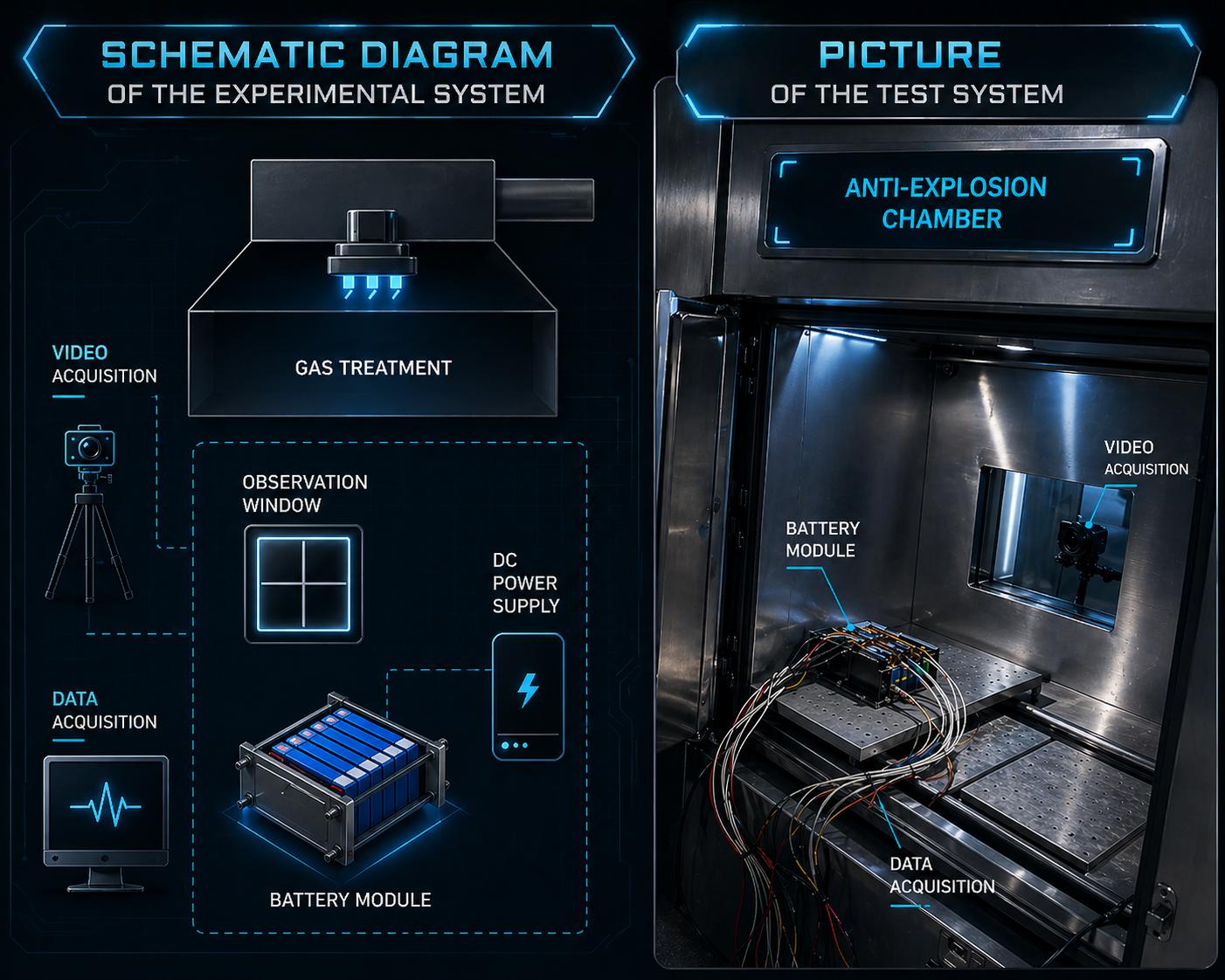
- configuration of a multi-module system (up to 9 modules)
- selection of a trigger module with a high state of charge (SOC >95%)
- integration of sensors (internal/external thermocouples) and HV measurements
- data acquisition via DAQ, CAN and video.
The trigger is initiated through a controlled heating pad (~300W) applied to the trigger module.
Monitoring and data acquisition
During the test, the system is monitored in real time to collect multi-domain data, which are essential for engineering validation. The following are analyzed:
- temperature profiles (intra-module and inter-module)
- HV voltages and currents
- BMS signals and CAN communication
- visual events (venting, flames, propagation)
This enables a multi-domain correlation between thermal, electrical, and mechanical phenomena.
Safety and containment strategies
A central aspect of the validation concerns the effectiveness of both active and passive safety systems.
The procedure adopted by Reinova includes automatic intervention logics, such as:
- nebulization activated above 120°C on bunker walls
- activation above 250°C in fumes
- combined systems including:
- internal flooding
- active cooling
- fire suppression systems
These conditions make it possible to test not only the product, but also the robustness of the overall safety architecture.
Engineering validation and design implications
Results from tests such as thermal propagation provide direct and concrete input for product improvement, influencing:
- battery enclosure design
- module-to-module isolation strategies
- BMS algorithms for fault management
- material selection (thermal barriers and heat dissipation)
In a B2B context, this translates into:
- increased bankability of BESS systems
- reduced insurance and risk costs
- accelerated certification and homologation processes
The value of the partnership between Archimede Energia and Reinova
The collaboration with Reinova enables Archimede Energia to integrate key competencies throughout the entire process:
- in-house design
- advanced testing in controlled environments
- independent validation
The result is a complete battery certification process, aimed at ensuring performance and safety throughout the entire product lifecycle.
From validation to scalability
For B2B customers, safety is not just about compliance: it is a key enabler for the scalability of energy solutions.
Through structured activities such as thermal runaway testing and battery certification, Archimede Energia strengthens its positioning as a reliable technology partner for high-criticality applications.
Would you like to learn more about our validation processes or evaluate a collaboration?
Contact us to discuss your project requirements.